

$36.92
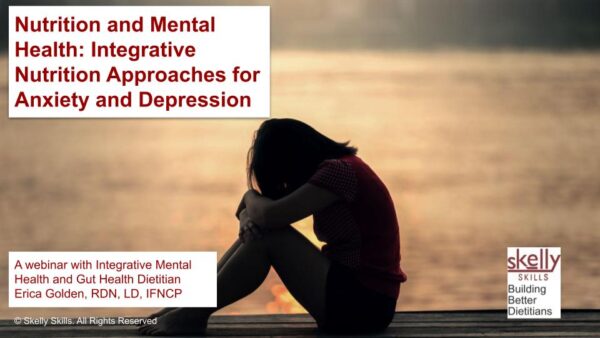
On-demand Webinar! Learn how to take a root cause approach in your mental health nutrition counseling sessions, with this informative webinar with Integrative Mental Health and Gut Health Dietitian Erica Golden, RDN, LD, IFNCP, author of the brand-new CE course Nutrition and Mental Health: Integrative Approaches for Diet, Dysfunction and the Gut-Brain Axis (27 CPEUs). You’ll learn:
Don’t miss this opportunity to add this valuable set of skills and knowledge to your practice!
This webinar is CDR-approved for 1 CPEU for RD/RDNs and DTR/NDTRs, and CBDCE-approved for 1 CEU for CDCESs.
Learn How Webinar CEs Work
CPEU/CEU: 1
Course Expiration Date: 9/26/2026. You have until that date to complete your CPEU Evaluation or Webinar Feedback Survey for this course.
Learn more about course expiration dates.
The CDR Activity Number for this course is: 178704
Nutrition and Mental Health: Integrative Nutrition Approaches for Anxiety and Depression On-demand Webinar
Course Type: 175—Recorded Pre-Approved CPE
Suggested Learning Level: 1
On-demand Webinar! Learn how to take an integrative nutrition approach to provide comprehensive care for your clients with mental health conditions!
Learning Objectives:
Learn how to address underlying gut-brain axis dysfunction in your clients with anxiety and depression. Equip yourself with knowledge to apply trauma-informed care in your practice. Gain confidence in taking an integrative nutrition approach with your clients to achieve optimal well-being and health. Nutrition and Mental Health: Integrative Nutrition Approaches for Anxiety and Depression webinar will deliver the knowledge you need to elevate your mental health practice and patient outcomes.
See the LNCs & PIs tab for suggested learning codes.
Discover Skelly Skills’ other counseling, education, and communication CE courses.
Learn more about speaker Erica Golden, RDN, LD, IFNCP.
CPEU/CEU: 1
NOTE: Course Expiration Date: 9/26/2026. You have until that date to complete your CPEU Evaluation or Webinar Feedback Survey for this course.
1.1.1 Participates and documents engagement in professional development activities to maintain and enhance competence.
1.1.2 Pursues and embraces opportunities to advance practice.
1.1.3 Keeps abreast of changes in practice and in the practice environment that affect individual competence and legislative scope
1.1.5 Integrates new knowledge and skills into practice.
1.3 Recognizes and manages situations with ethical implications.
1.4 Respects client autonomy to make decisions about proposed services.
1.7 Applies cultural competence and consideration for social determinants of health to show respect for individuals, groups and populations.
1.7.3 Develops awareness of one’s own personal beliefs and values to inform and reduce biases.
2.1.1 Assesses the communication needs of individuals, groups and populations to provide effective communication.
2.2.2 Delivers information and opinions in a respectful and professional manner.
4.1 Demonstrates sound professional judgement and strategic thinking in practice.
4.1.2 Interprets and integrates evidence-based research and literature in decision-making.
4.1.3 Identifies misinformation and inaccurate information in order to inform decision-making.
4.2 Exercises critical thinking when faced with opportunities and challenges.
4.2.2 Reflects on own values, beliefs and biases.
4.2.3 Demonstrates insight concerning personal expertise and limitations.
4.2.4 Investigates alternative explanations for deficits or challenges and considers alternative methods and provides justification for selected option(s).
4.2.5 Analyzes and synthesizes information and identifies new information, patterns and findings.
4.2.6 Integrates relevant information with previous learning, experience, professional knowledge, and current practice models.
6.1.1 Identifies gaps in evidence to determine research priorities.
6.1.4 Defines and establishes appropriate research methodology approaches (e.g. quantitative and qualitative methods).
6.2.3 Analyzes and interprets data to form valid conclusions and to make recommendations.
6.3.1 Accurately and ethically shares research findings with a variety of audiences.
6.3.2 Utilizes innovative ways to disseminate research findings considering the target audiences.
6.8.1 Masters and maintains current and evidence-based knowledge within subject areas.
8.1.1 Interprets and applies evidence-based comparative standards for determining nutritional needs.
8.1.2 Applies knowledge of food and nutrition as well as the biological, physical and social sciences in practice.
8.1.4 Integrates knowledge of macro- and micronutrients for digestion, absorption and metabolism throughout the lifespan in practice.
8.1.5 Applies medical nutrition therapy in disease prevention and management.
8.2.1 Assesses the physical, social and cultural needs of the individual, group, community or population.
8.2.2 Applies knowledge of health determinants when planning, developing and implementing services, programs, meal plans and menus.
8.2.3 Analyzes new information and how it impacts medical nutrition therapy.
8.2.4 Integrates new knowledge of disease states and clinical conditions into practice.
8.3.1 Discusses with clients the Physical Activity (PA) Guidelines for Americans and the relationships between exercise, health, and disease prevention.
8.3.4 Assesses clients’ emotions toward nutrition-related statements or phenomenon, body image/preoccupation with food and
weight, and readiness to change nutrition-related behaviors.
8.4 Critically evaluates the safety and efficacy of integrative and functional medicine approaches and interventions.
8.4.1 Gains an understanding of integrative and functional medicine models and interventions and how these models and interventions are applied to nutrition and dietetics service.
8.4.2 Critically evaluates the credibility of integrative and functional medicine research and literature, using evidence-based criteria, to respond to inquiries and to determine the appropriateness of incorporating these interventions into nutrition care plans.
8.4.3 Identifies research gaps to support conscious decision-making.
8.4.4 Identifies safety issues, risks, efficacies, benefits and limitations of interventions.
8.4.5 Critically evaluates the safety and efficacy of traditional and pharmaceutical models.
8.5.4 Takes into consideration client/patient choices, beliefs, food sensitivities, allergies, and accessibility and affordability of food.
9.1.3 Identifies and analyzes factors that influence change in behaviors.
9.2.1 Assesses learning needs of the individual or target group.
9.4.6 Uses socially and culturally appropriate strategies in order to respect diverse cultures and values.
9.6.1 Assesses client/patient nutritional needs and appropriateness of the counseling.
9.6.2 Applies a variety of counseling theories, psychological methods and strategies that empower clients/patients to make changes.
9.6.8 Develops counseling or coaching goals in collaboration with clients.
9.6.11 Refers client/patient to appropriate professionals when counseling, therapy or mental health status is beyond competence and legislative scope of practice.
10.1.2 Conducts nutrition screening to identify client/patient risks and levels of criticality, and to direct services.
10.2.1 Selects valid and reliable tools to conduct comprehensive nutrition assessments.
10.2.3 Collects information related to client/patient use of medications, dietary supplements and integrative and functional medicines to identify potential adverse drug and nutrient interaction.
10.2.8 Recommends biochemical tests and reviews results to support diagnoses and plans of care.
10.2.9 Orders biochemical tests and reviews results to support diagnoses and plans of care.
10.2.12 Gathers information that affects intake and nutrition and health status (e.g., cultural, ethnic, religious, lifestyle influencers, psychosocial, and social determinants of health).
10.3.3 Prioritizes specific nutrition problems to inform nutrition care plans and processes.
10.3.4 Selects interventions intended to resolve or improve nutrition diagnoses.
10.4 Prescribes, recommends and administers nutrition-related pharmacotherapy to support optimal patient/client outcomes according to standard of practice, legislation and organizational policies.
10.4.1 Identifies classifications of nutraceutical pharmacological agents and the action on the body.
10.4.3 Identifies potential food-nutrient drug interactions based on physiological responses to pharmacological agents and takes appropriate action.
10.4.4 Considers client/patient factors, nutritional impacts, indications, side effects, contraindications, benefits, risks, alternatives and foundational sciences when prescribing, recommending or administering nutrition-related drug therapy.
10.4.7 Evaluates, educates and counsels on the interrelationship and impact of pharmacotherapy on nutrients.
10.5.1 Reevaluates and adjusts plans of care to support client/patient health goals.
10.5.2 Monitors and identifies factors affecting client/patient progress in meeting goals.
10.5.3 Adjusts interventions based on client/patient progress in meeting established goals.
10.5.4 Establishes new goals and nutrition care plans when original or interim goals are met.
12.2.1 Identifies determinants of health and influences on population health status.
Only logged in customers who have purchased this product may leave a review.

CPEU/CEU: 41
CPEU/CEU: 21
CPEU/CEU: 35
From: $318.82 Select options This product has multiple variants. The options may be chosen on the product page
CPEU/CEU: 1

Skelly Skills offers two types of Continuing Education (CE), also known as Continuing Professional Development (CPD). The two types of CDR-approved CE we offer are:
For each of these types of CE, we offer Continuing Professional Education Units (CPEUs — also called CEUs, clock hours, or CPD hours).
Our prior approved enduring CE courses all include a CE exam. This is important for some of you because you *may* be limited by the number of prior approved enduring (aka self-study) hours you can accumulate. For each course, you will need to complete the CE exam through our online testing system. It’s easy and you’ll get your CE Certificate of Completion as soon as you pass the course (or complete the Feedback Survey, in the case of our one-hour on-demand CE webinars).
Our live CE webinars include a Feedback Survey. Within 24 hours of the live webinar, we will send an email with the Assessment ID and Key ID to complete the Feedback Survey through our testing system. Once you complete that, you’ll immediately be able to print and/or download your CE Certificate of Completion (it will also be emailed to you).
Step 1: Visit Skelly Skills and choose the topic and book or other course type you want to study. The number of CPEUs/CEUs/CPD hours are shown on each product page. Note to international customers: You can change the display currency using the icons on the right of the page.
Step 2: Pay online—you’ll get virtual courses immediately or else you’ll receive the book in the mail along with the CE exam booklet (we call this a ‘CE Evaluation’). Note: for books that we publish in-house, we include the CE exam and testing info in the back of the book, not as a separate booklet.)
Step 3: Study the course content. Once you have finished, complete the online exam at our testing site using the Assessment ID and Key ID (password) provided to you in the CE Evaluation, or on the course webpage if you are completing an on-demand webinar or online course.
That’s it! Once you have passed your exam, you’ll receive a PDF certificate of completion which includes the number of CPEUs/CEUs/CPD hours.


Purchase your webinar and receive a link to the webinar immediately.
Watch your webinar and then submit the CE Feedback Survey form by the course expiration date.
After submitting your CE Feedback Survey, you will be able to download your CPEU/CEU certificate as a pdf and keep for your records.

We use cookies to ensure you get the best experience. By using our website or clicking "accept", you consent to cookies.
N.M., MS, MPH, RD, Public Health/WIC Nutritionist and Consultant Dietitian –
Very good session with practical and easy-to-understand concepts detailed.
K.T., RDN, LD, Long-term Care and Consultant Dietitian –
It was incredibly informative and by far one of the best programs I have attended.
C.M., RDN, LD, CLS. Long-term Care Dietitian –
I am so impressed at the depth of this presentation material! Definitely needed given the limited resources available to dietitians within this scope of practice!!! Well done!
K.D., RD, LDN, Private Practice Dietitian –
This may have been the best free webinar I have ever attended. Blown away by what was covered in an hour. Another team member joined with me and I plan to provide the full CEU for her and I and others on our team due to how well laid out the information was, and how relevant it is to the population and niche we are planning on catering to. I feel like it took my general understanding of nutrition for mental health and dug in deeper, which is what I have been looking for. Looking forward to utilizing the speakers resources! Thank you!!!
M.S., RDN, Pediatric Outpatient Dietitian –
Excellent program and program topic. Very informative!
E.J.M., RDN, Clinical Manager –
I found the speaker’s area of practice VERY interesting. The combination of her client’s needs was new to me. I enjoyed the program immensely.
K.L., RD –
great! I learned so much and will be able to implement even small changes that help.
L.B., MFCS, RD, CD, LD –
Such great detail and I loved the research support of her statements and education. I appreciate her breaking down how we as RDs can implement some of these recommendations.