


$30.36
Newly revised and updated eArticle! Meet your CDR ethics requirement for your RD/RDN credential and learn the latest best practices and guidelines for using social media and digital technology responsibly and ethically. Features:
This course is CDR-approved for 1 CPEU for RD/RDNs and DTR/NDTRs, and CBDCE-approved for 1 CEU for CDCES’s. Please note course expiration date below.
Includes eArticle Download and CE Evaluation/Reporting Form: Submit your form online and receive your CE Certificate immediately.
CPEU/CEU: 1
Course Expiration Date: 10/7/2028. You have until that date to complete your CPEU Evaluation or Webinar Feedback Survey for this course.
Learn more about course expiration dates.
The CDR Activity Number for this course is: 189828
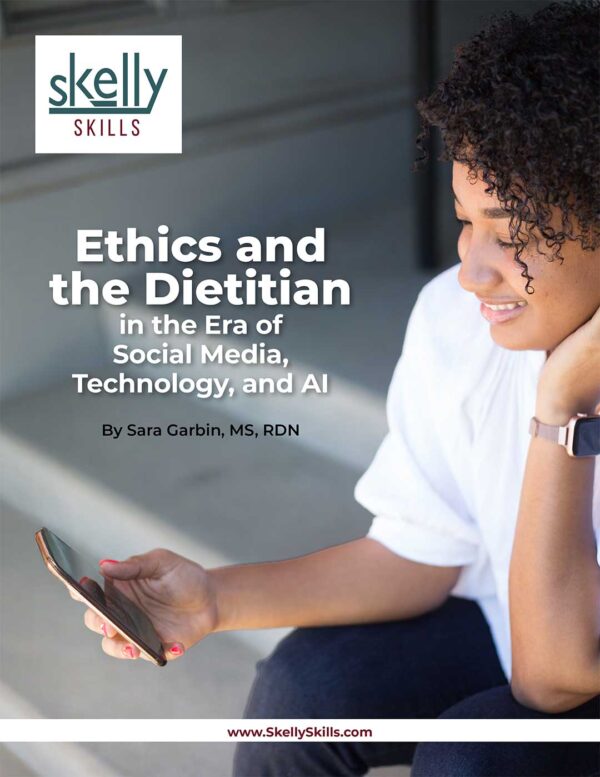
Ethics and the Dietitian in the Era of Social Media, Technology, and AI Article + CE Evaluation (Quiz)
Course Type: 741—Enduring Activity
Includes CE Evaluation/Reporting Form: You will submit it online and receive your CE Certificate immediately.
Suggested Learning Level: 1
Meet your Ethics CE requirement with this informative and relevant course! Social media and artificial intelligence (AI) offer the potential to enhance professional reach and improve efficiency and client outcomes. Learn how to take advantage of this innovative technology responsibly and ethically.
Learning Objectives:
At the conclusion of this article, readers will be able to:
Technology is rapidly evolving. Ethics and the Dietitian in the Era of Social Media, Technology, and AI article and CE course delivers timely, practical guidance to help nutrition professionals navigate the digital landscape with professionalism, integrity, and confidence.
Published 2025. 9 pages.
1 CPEU CE Course. See the PIs tab for suggested Performance Indicators.
Reading the article Ethics and the Dietitian in the Era of Social Media, Technology, and AI and successfully passing the CE exam awards 1 CPEU in accordance with the Commission on Dietetic Registration’s CPEU Prior Approval Program.
Discover Skelly Skills’ other electronic book and electronic article CE courses.
Learn more about the Code of Ethics for the Nutrition and Dietetics Profession.
CPEU/CEU: 1
NOTE: Course Expiration Date: 10/7/2028. You have until that date to complete your CPEU Evaluation or Webinar Feedback Survey for this course.
1.1.1 Participates and documents engagement in professional development activities to maintain and enhance competence.
1.1.2 Pursues and embraces opportunities to advance practice.
1.1.3 Keeps abreast of changes in practice and in the practice environment that affect individual competence and legislative scope
of practice.
1.1.5 Integrates new knowledge and skills into practice.
1.1.6 Recognizes and exercises professional judgment within the limits of individual qualifications.
1.2.1 Recognizes and discloses any conflicts of interest, including any financial interests in products or services.
1.2.2 Keeps abreast of and complies with federal, state/territory, and local and/or tribal legislation, regulations, policies and standards.
1.2.3 Models organizational mission and vision statements, principles and values.
1.2.4 Maintains and appropriately uses credentials and certifications.
1.2.5 Respects intellectual property rights, including citations and recognition of the ideas and work of others.
1.2.6 Provides accurate and truthful information in all communications.
1.2.7 Reports inappropriate, unethical or incompetent behavior or treatment of others.
1.3.1 Recognizes actual or potential ethical issues and dilemmas encountered in practice.
1.3.2 Uses an ethical framework to guide decisions.
1.3.3 Uses ethical reasoning and decision-making processes to address ethical dilemmas.
1.4.4 Demonstrates awareness that informed consent is an ongoing process.
1.4.5 Identifies situations in which informed consent is problematic and rectifies issues appropriate to the situation.
1.5.4 Effectively manages changes in professional interactions to maintain professional boundaries.
1.5.5 Demonstrates professional behaviors and professional boundaries when using various media and online platforms.
1.6.1 Implements appropriate measures to protect personal health information (e.g., encryption, password protection).
1.6.2 Safeguards client confidentiality when sharing, transmitting, storing or destroying personal health information.
1.6.3 Obtains consent for the collection, storage, use and disclosure of personal and health information.
1.6.4 Adheres to legislative requirements and facility/employer guidelines regarding protection of privacy and security of
information.
1.6.5 Takes action to anticipate and minimize foreseeable risks to privacy and confidentiality.
1.6.6 Supports others in meeting their professional obligations to maintain confidentiality and privacy of personal information.
1.7.5 Applies knowledge of cultural foods, religious traditions, eating patterns and food and nutrition trends.
2.1.3 Reflects on how personal biases, privilege, and beliefs influence interpretation of evidence and research and changes behavior
accordingly.
2.1.8 Reviews, revises and updates policies and practices within organizations to ensure that norms are shaped with anti-discrimination
practices.
3.1.2 Identifies and addresses barriers to effective communication.
3.1.4 Uses a variety of media for effective communication.
3.1.5 Evaluates the effectiveness of communication methods used to ensure understanding of presented information.
3.2.2 Delivers information in a respectful and professional manner.
3.2.3 Delivers accurate and credible messaging.
3.2.4 Ensures written communications are timely, clear, legible, accurate and professional in nature.
3.2.5 Applies pertinent legislation and organization policies in communications.
3.3.2 Considers and respects the opinions, creativity, values, beliefs and perspectives of others.
3.3.3 Identifies opportunities for mutually beneficial partnerships with individuals or organizations with shared visions.
3.3.5 Demonstrates conflict resolution and mediation skills.
4.1.2 Fosters a collaborative team culture that values diversity and high ethical standards.
4.1.3 Demonstrates ability to proactively develop and manage change.
4.2.3 Interprets legal terminology used to establish nutrition regulations and policies to support knowledge translation.
5.2.6 Integrates relevant information with previous learning, experience, professional knowledge, and current practice models.
6.1.2 Applies understanding of informatics terminology and input and output devices (e.g., food and nutrition management systems,
electronic health record (EHR), relational databases, wearables, cloud platforms, AI-driven tools).
6.1.5 Demonstrates principles of electronic file organization, including information storage, data protection, cybersecurity best practices
and basic computer skills to ensure compliance with privacy standards (e.g., HIPAA).
6.1.10 Seeks skills and knowledge to maintain proficiency and adapt to evolving technology advancements, including emerging tools,
systems, and innovations in healthcare (or nutrition) informatics.
6.2.1 Integrates technology platforms with other internal and external services (e.g., diet order entry system, risk management, disease
management, telehealth, data analytics).
6.2.6 Develops and implements HIT policies and procedures that align with privacy, security and confidentiality legislation and
regulation.
6.3.1 Complies with legislative requirements and organizational policies for collecting, using, maintaining, storing, sharing and
appropriately destroying personal health information.
6.3.2 Maintains security, confidentiality, and integrity in the electronic sharing, transmission, storage and destruction of information,
incorporating up-to-date security methods and secure cloud storage practices.
6.3.4 Takes appropriate action in response to unauthorized access, use and disclosure of information.
6.3.5 Understands emerging technologies (e.g., AI, machine learning) and associated ethical considerations, including bias, data
ownership, transparency, and the responsible use of data by healthcare professionals or clients.
7.3.1 Accurately and ethically shares research findings with a variety of audiences.
10.3.5 Uses a variety of strategies to deliver education including telehealth and social media.
10.4.7 Demonstrates competent use of technology to enhance learning experiences and the delivery of information.
11.6.2 Adheres to legislative and organizational requirements regarding protection of privacy, security of information and storage and disclosure of client/patient records
12.4.1 Stays abreast of changing trends and technology in promotion, marketing and advertising products and services.
12.4.2 Adheres to advertising regulations and organizational policies.
12.4.3 Ensures advertising information is evidence-based, balanced, accurate and in the public’s best interest.
Only logged in customers who have purchased this product may leave a review.
CPEU/CEU: 16

CPEU/CEU: 1

CPEU/CEU: 1
Skelly Skills offers two types of Continuing Education (CE), also known as Continuing Professional Development (CPD). The two types of CDR-approved CE we offer are:
For each of these types of CE, we offer Continuing Professional Education Units (CPEUs — also called CEUs, clock hours, or CPD hours).
Our prior approved enduring CE courses all include a CE exam. This is important for some of you because you *may* be limited by the number of prior approved enduring (aka self-study) hours you can accumulate. For each course, you will need to complete the CE exam through our online testing system. It’s easy and you’ll get your CE Certificate of Completion as soon as you pass the course (or complete the Feedback Survey, in the case of our one-hour on-demand CE webinars).
Our live CE webinars include a Feedback Survey. Within 24 hours of the live webinar, we will send an email with the Assessment ID and Key ID to complete the Feedback Survey through our testing system. Once you complete that, you’ll immediately be able to print and/or download your CE Certificate of Completion (it will also be emailed to you).
Step 1: Visit Skelly Skills and choose the topic and book or other course type you want to study. The number of CPEUs/CEUs/CPD hours are shown on each product page. Note to international customers: You can change the display currency using the icons on the right of the page.
Step 2: Pay online—you’ll get virtual courses immediately or else you’ll receive the book in the mail along with the CE exam booklet (we call this a ‘CE Evaluation’). Note: for books that we publish in-house, we include the CE exam and testing info in the back of the book, not as a separate booklet.)
Step 3: Study the course content. Once you have finished, complete the online exam at our testing site using the Assessment ID and Key ID (password) provided to you in the CE Evaluation, or on the course webpage if you are completing an on-demand webinar or online course.
That’s it! Once you have passed your exam, you’ll receive a PDF certificate of completion which includes the number of CPEUs/CEUs/CPD hours.


Purchase your webinar and receive a link to the webinar immediately.
Watch your webinar and then submit the CE Feedback Survey form by the course expiration date.
After submitting your CE Feedback Survey, you will be able to download your CPEU/CEU certificate as a pdf and keep for your records.

We use cookies to ensure you get the best experience. By using our website or clicking "accept", you consent to cookies.
Meredith Godfrey, MS, RD, LD Atlanta, GA –
I liked how it gave insight about the use of AI as this is something new that has not been addressed before.
Rebecca Oosterhout, MS, RDN, CD, FMNS, CLT –
Very helpful in providing an awareness of the concerns with social media and AI, and how to address with professionalism.